The "Pixel Cost" Crisis: Why Zero-Click Search Is Killing Your Retargeting Funnel (And the New Math to Fix It)
AI Overviews and zero-click search aren't just stealing your traffic — they're destroying the retargeting layer your entire paid media strategy depends on. Here's the hidden cost no one's calculating, and a new framework for valuing the leads you never knew you had.
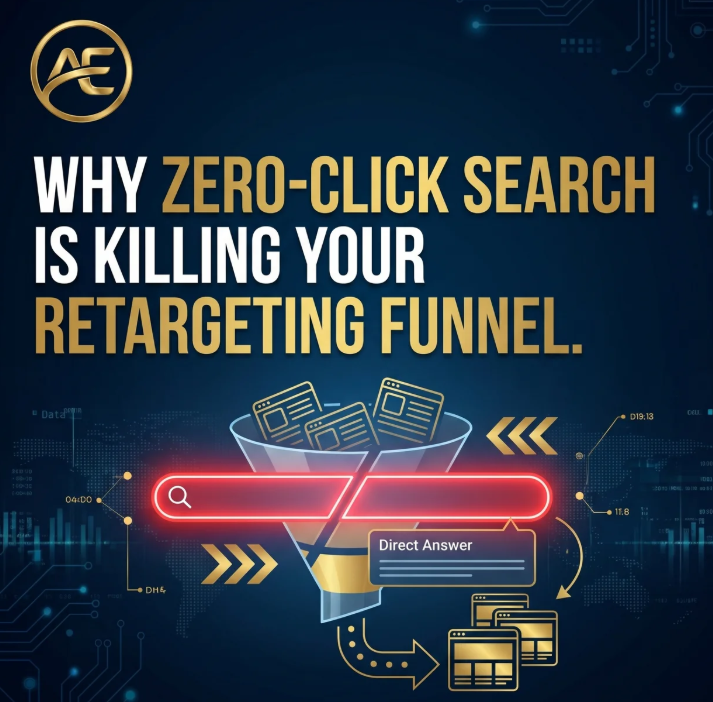
The "Pixel Cost" Crisis: Why Zero-Click Search Is Killing Your Retargeting Funnel (And the New Math to Fix It)
- AI Overviews now answer 47% of search queries without a click. Those users are never cookied.
- No cookie = no retargeting. Your LinkedIn and Meta audiences are shrinking in silence.
- The "Pixel Cost" is the invisible revenue loss when a high-intent buyer gets their answer from an AI and disappears.
- The fix isn't more ad spend. It's Citation Attribution — treating AI mentions as top-of-funnel leads with measurable pipeline value.
- Brands optimised for AI citation are building retargetable audiences through alternative signals: email capture, brand search lift, and dark social tracking.
Something broke in paid media in 2024 and most performance marketers still haven't named it.
Your retargeting audiences are shrinking. CPMs are climbing. ROAS is softening. And the standard explanations — iOS privacy changes, cookie deprecation, increased competition — only tell part of the story.
The missing variable is this: a growing percentage of your highest-intent buyers are getting their questions answered by AI before they ever touch your site. They're reading an AI Overview on Google, getting a cited summary from Perplexity, or asking ChatGPT for a product recommendation. They form an opinion. They move on.
You never saw them. Your pixel never fired.
This is the Pixel Cost Crisis.
What Is the "Pixel Cost" and Why Does It Matter Now?
The Pixel Cost is the revenue value of retargeting opportunities permanently destroyed by zero-click AI answers. A user searches a high-intent query, gets a satisfying answer from an AI Overview or generative engine, and closes the tab — without landing on any page your pixel could track.
It's not a new concept to describe lost traffic. Marketers have talked about zero-click search for years. The shift in 2025 is the intent level of the queries now being answered without a click. Google's AI Overviews have expanded rapidly into commercial, comparison, and "best of" query types — exactly the searches that used to generate your warmest retargeting segments.
According to data from SparkToro and Datos published in early 2025, roughly 60% of all Google searches end without a click to any website. That number rises above 70% on mobile. The Pixel Cost isn't a marginal rounding error. It's your majority traffic problem.
The Retargeting Gap: Where High-Intent Buyers Disappear
The retargeting funnel has always depended on one thing: the user lands on your site and gets cookied. That cookie is the entry point to your LinkedIn Matched Audience, your Meta Custom Audience, your Google remarketing list.
The classic model looks like this:
Search query → click → landing page → pixel fires → retargeting begins
AI Overviews and generative engines broke step two. The new reality for a growing percentage of your commercial queries looks like this:
Search query → AI answer → user satisfied → session ends → no pixel → no retargeting
This isn't a nuance. It's a structural break in the demand capture layer. The buyer had intent. They got information. You had no visibility into either event.
The category of queries where this is happening most aggressively: comparison queries ("X vs Y"), "best for" queries, definition and explainer queries, pricing transparency queries, and "how does [product category] work" queries. These are, not coincidentally, your highest-converting retargeting segments.
Brands in SaaS, financial services, B2B professional services, and high-consideration ecommerce are absorbing the largest Pixel Cost. If your average sales cycle is longer than two weeks and you rely on retargeting to nurture consideration, the math is working against you.
Calculating Your Own Pixel Cost
This is back-of-envelope math, but it produces a number that focuses attention fast.
Start with your monthly organic search impressions for commercial-intent queries. Take your average click-through rate. The gap between impressions and clicks — the "no-click zone" — contains a percentage of high-intent users who were served AI answers.
Conservative estimate: 20-30% of your no-click commercial impressions in 2025 involve an AI answer. More aggressive estimates from SEO researchers push that figure past 40% for informational-commercial hybrid queries.
Pixel Cost formula (simplified):
No-click commercial impressions × AI answer rate × historical conversion rate from retargeting × average deal value = Pixel Cost per month
Run that against a modest traffic set — say, 50,000 monthly impressions on commercial queries, 35% in the no-click zone, 15% estimated AI-served — and you're looking at 2,625 prospects per month who had intent and are completely invisible to your retargeting stack.
If your retargeting historically converts at 2% and your deal value is £1,000, that's £52,500 in potential pipeline you can't even see, let alone capture.
The Citation Attribution Framework: Valuing Invisible Intent
The answer isn't to abandon retargeting. It's to extend your definition of a "lead event" beyond the pixel fire.
The Citation Attribution Framework treats an AI mention of your brand as a measurable top-of-funnel signal. Here's how it works in practice.
Step 1: Establish Your AI Citation Baseline
Use tools like Perplexity, ChatGPT, and Google AI Overviews to audit which queries in your category produce AI answers — and which brands get cited. Run your top 50 commercial queries through each engine. Record which competitors appear as citations and which don't.
This is your benchmark. Brands cited in AI answers are capturing the intent you're losing.
Step 2: Map Citation Velocity to Brand Search Volume
When your brand gets cited in AI answers at scale, it produces a measurable downstream effect: branded search volume increases. Users see your brand name in an AI response, close the tab, and search your brand directly days later. This "dark intent" signal shows up in Google Search Console as branded query impressions.
Track this correlation monthly. A 15% increase in branded impressions against flat or declining non-branded impressions is a reliable signal that AI citation is driving discovery.
Step 3: Assign Pipeline Value to AI Citations
This is where Citation Attribution becomes a financial model, not just a theory.
If you know that 1,000 branded searches historically produce X pipeline at Y close rate, and you can show that AI citation is responsible for a measurable lift in branded searches, you can backsolve the pipeline value of each AI citation event.
The formula isn't precise — but it doesn't need to be. It needs to be credible enough to justify shifting a portion of your content investment from traditional SEO to AEO-optimised content that earns AI citations.
Most performance marketers who run this model find that a reliable AI citation in a high-volume query is worth between £150 and £600 in attributable pipeline value. For enterprise brands with higher deal values, that figure is materially larger.
What Replaces the Lost Retargeting Signal?
There's no single replacement. There are four signals that collectively fill the gap.
1. Brand Search Lift The most reliable downstream proxy for AI citation volume. Measure weekly branded impressions in Search Console. Establish a baseline. Anything above trend correlates with either paid brand activity or organic AI citation. If you're not running brand spend and branded search is rising, AI citation is working.
2. Email Capture on AI-Adjacent Content Create content that sits one step downstream from the AI answer. If an AI Overview answers "what is AEO," your job is to own the next query — "how do I implement AEO" or "AEO audit checklist." These pages convert to email capture more efficiently than top-of-funnel awareness content, because the user already has base-level knowledge from the AI.
3. Dark Social Tracking AI-cited brands appear in Slack conversations, WhatsApp groups, email threads, and Discord servers. This dark social sharing doesn't produce referral traffic — but it does produce direct navigation sessions. A sustained increase in "direct" sessions in your analytics, absent any PR or offline activity, is often dark social from AI-driven awareness.
4. LinkedIn Content Engagement as Intent Signal Users who've encountered your brand in an AI answer are more likely to engage with your LinkedIn content on first exposure. Monitor connection request spikes and post engagement from target-account employees following periods of active AI citation. It's qualitative, but it's pattern-detectable.
How to Start Capturing Invisible Intent: The AEO Content Play
The practical response to the Pixel Cost Crisis is not defensive. It's offensive. You get into the AI answer — and then you build a capture layer underneath it.
Get cited first. AI citations are earned through content that answers questions with authority, precision, and structural clarity. AI engines extract answers that are direct, factually dense, and clearly sourced. Vague brand content doesn't get cited. Specific, answer-first content does.
This is what Answer Engine Optimisation (AEO) addresses directly. Structure your content so the first 100 words of every page directly answer the target query. Include quotable definitions, verifiable statistics, and FAQ sections that mirror conversational search patterns.
Then build the capture layer. Every piece of AEO-optimised content should have a downstream hook: a lead magnet, an email capture, a free audit offer — something that converts the user who arrives already warmed by the AI answer they read 20 minutes earlier.
The retargeting gap doesn't get smaller. AI Overviews are expanding. Perplexity's user base is growing at double-digit rates month on month. The brands that build an AI citation presence now are building a top-of-funnel asset that compounds — without paying for every impression.
Frequently Asked Questions
What is zero-click search and why is it growing?
Zero-click search happens when a user's query is answered directly in the search results page — by an AI Overview, featured snippet, or knowledge panel — without the user clicking through to any website. It's growing because AI systems like Google's Gemini-powered Overviews can now synthesise multi-source answers in real time, satisfying commercial and informational queries without requiring the user to visit an external page. Google's own data shows AI Overviews appear on over 25% of all queries as of 2025, with that figure continuing to expand.
How does zero-click search affect retargeting campaigns?
If a user reads an AI-generated answer and leaves the search results page without clicking any link, no website pixel fires. That user's intent is never captured in any retargeting platform — not Google, not Meta, not LinkedIn. This means your retargeting pool is shrinking even as overall search volume for your category may be stable or growing. The loss is concentrated in your highest-intent query types: comparison queries, "best for" queries, and consideration-stage questions.
What is the Pixel Cost in digital marketing?
The Pixel Cost is the monetised value of retargeting opportunities destroyed by zero-click AI search. It represents the pipeline you can't see, can't target, and can't measure through traditional analytics — because the user had intent, was partially informed by your category, and then disappeared before any tracking event occurred.
What is the Citation Attribution Framework?
The Citation Attribution Framework is a method for assigning pipeline value to AI engine citations of your brand — even when those citations produce no direct click. It works by correlating AI citation volume with downstream measurable signals: branded search lift, direct session increases, and email capture conversion rates. The framework allows marketers to make an ROI case for AEO investment using familiar revenue metrics rather than traffic or impression counts.
Can you retarget users who found you through an AI answer?
Not directly through pixel-based retargeting. But you can create conditions that increase the probability of a direct visit. AEO-optimised brands show consistently higher rates of branded search from users who encountered them in AI answers — these direct searches can then be captured through branded search ads. This isn't the same as cookie-based retargeting, but it produces a similar nurture effect with a shorter path to conversion.
What's the difference between AEO and traditional SEO?
Traditional SEO optimises for ranking on the search engine results page so users click through to your site. AEO — Answer Engine Optimisation — optimises for being cited directly within AI-generated answers, even when no click occurs. AEO content is structured to be extractable: direct answers, quotable definitions, high-information-density claims, and FAQ sections that match conversational query patterns. Both disciplines matter, but AEO addresses the zero-click layer that traditional SEO was never designed for.
How do you measure the ROI of AEO investment?
Measure AEO ROI through three proxies: branded search volume lift in Google Search Console (correlates with AI citation at scale), direct session volume against a pre-AEO baseline, and email capture rates from content that sits one step downstream from AI-answered queries. Assign pipeline value using your historical retargeting and branded search conversion rates. The model is imprecise but directionally reliable — and it produces a credible number for budget justification.
Practical Takeaway
The Pixel Cost is real and it's growing. But it's not an unsolvable problem — it's an optimisation problem. The brands winning in this environment are doing two things: earning AI citations so they stay visible in the zero-click layer, and building content capture infrastructure one step downstream from every AI answer they own. Audit your top 30 commercial queries in an AI engine today. Note which competitors appear as citations. That's your competitive gap — and the starting point for the only retargeting strategy that works in a world where half your buyers never click.
Related Articles
Article
LLM Citation Engineering Services: What You Should Actually Pay in 2026
AI search now cites sources instead of ranking pages, and "citation engineering" agencies have appeared to charge for it. Here is the real cost breakdown for 2026, what each line item actually buys, and how to tell a fair quote from a repackaged SEO retainer.
Article
How to Get Your Brand Cited in Gemini AI Answers Consistently
Google's AI Overviews now sit above the organic results for most high-intent searches, and Gemini is choosing which brands to name. Here's the exact structure that gets you cited consistently, not just occasionally.
Article
How Much Does an AEO Agency Cost? (2026 Pricing)
AEO agency pricing stopped working like SEO pricing in 2026. Here's what retainers actually cost, the hidden tool-markup tax driving the floor up, and how to tell whether you're paying for real citation work or an SEO retainer with a new sticker.
Want content like this written for your brand, daily?