100/100 Content Score, Zero AI Citations: The Hidden Metric Costing You AI Traffic
Your Surfer content score is perfect. Google ranks it. But ChatGPT never mentions you. Perplexity cites competitors instead. The gap isn't your content quality—it's that you're optimizing for the wrong metric. AI visibility requires a completely different measurement.
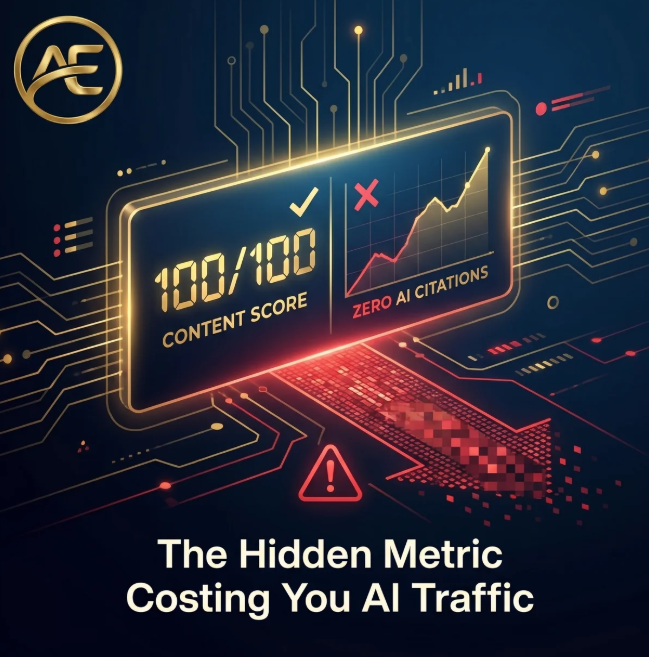
You can have a perfect content score (100/100 in Surfer, high SEO metrics) and still be invisible in ChatGPT, Perplexity, and Google AI Overviews. This is happening at scale right now. The problem: content quality metrics (word count, keyword density, structure) don't predict AI citations. LLMs select sources based on originality, authority, and "information gain"—signals your SEO tool never measures. The fix isn't more optimization. It's measuring the right layer.
The Surfer Paradox: Why Perfect Scores Miss the AI Layer
You've been playing one game really well. Google rankings. Your SEO tool scores content on structure, keyword placement, topical completeness, and competitive matching. A 100/100 score means your page ticks all the boxes that made competitors rank.
This works for Google.
It doesn't work for AI systems.
Here's the exact scenario founders are hitting right now: You publish a Surfer-optimized article. Word count is right (2,500 words). Headings match the competitive landscape. Keywords are distributed perfectly. FAQPage schema is in place. You hit publish. Within 90 days, it ranks in Google's top 3 for your primary keyword.
Traffic comes in. Organic growth is solid. By every traditional SEO metric, this is a win.
But when you ask ChatGPT the question your article answers, your brand doesn't appear. You ask Perplexity. Nothing. Google AI Overviews feature a competitor's 1,200-word article instead.
This isn't a fluke. This is happening systematically. Founders with dozens of perfectly-scored Surfer articles are seeing zero AI citations.
The root cause: Surfer measures the wrong things.
Why SEO Content Scores Don't Predict AI Selection
Content quality metrics in traditional SEO tools are trained on one signal: Google's top-ranking pages. They analyze word count, keyword frequency, heading structure, and topical breadth. Then they teach you to match that pattern.
This logic made sense in 2015–2023 when Google was the only search mechanism.
LLMs broke that model.
When ChatGPT generates an answer, it isn't running the Google ranking algorithm. It's doing something completely different: searching its training data and real-time web results, then synthesizing an answer by selecting the highest-confidence, most-authoritative sources that satisfy the specific intent of the prompt.
This requires different signals.
An LLM doesn't care if your article has exactly 8 internal links or matches the H2 structure of top competitors. It cares about: Is this source known and trusted? Does it have original insight? Is it being mentioned on other authoritative platforms? Does it answer this specific conversational intent better than alternatives?
Surfer doesn't measure any of those.
A perfect Surfer score tells you: "This page is structured like a top-ranking page." It doesn't tell you: "This page will be selected in AI synthesis." They're two different predictions.
The Information Gain Gap: Why Homogenised Content Loses
Here's the technical reason why volume-based SEO strategies fail in AI visibility: homogenisation penalty.
When 50 pages are optimized to match the same competitive landscape, they all start to sound the same. They cover the same points, use similar language, and hit the same structural targets. This is intentional in SEO. You want to match winners.
But LLMs detect this homogeneity and treat it as a quality signal in the opposite direction.
Think about how ChatGPT or Perplexity breaks down a complex question. It doesn't ask, "Which page has the best structure?" It asks: "What is this person really trying to understand?" Then it searches for sources that provide information gain—new facts, original analysis, or perspectives it hasn't seen before.
When it encounters 10 Surfer-optimized articles all saying similar things, it gets lower signal value from each one. When it finds an older, messier Reddit thread that shares actual lived experience or unique constraints, it gets higher signal value.
This is why Reddit threads often get cited over polished blogs. Not because Reddit is better at following SEO best practices. Because Reddit is less homogenised. It has variance. It has voice. That variance signals genuine information to an LLM.
Surfer teaches you to eliminate variance. Make your article match top performers. Structure like they structure. Cover what they cover. This is correct for Google. It's backwards for AI.
The Real Metrics That Drive AI Citations
Founders who are getting cited in ChatGPT, Perplexity, and Google AI Overviews aren't optimizing for content scores. They're optimizing for different signals entirely.
Originality at the margin. Not a revolutionary thesis (LLMs don't care about that). But a specific angle, data point, or constraint nobody else has published. "Most AI content is 70% similar to other content in its topic cluster"—that stat drives LLM selection. A Reddit thread mentioning it gets cited. A generic blog doesn't.
Entity authority. Is this brand known to LLMs as an expert in this topic? This is built through consistent cross-platform mention in training sources. Wikipedia, GitHub, Reddit, HackerNews, established publications. Not through one perfect website. Through being corroborated everywhere.
Intent-matching specificity. When someone asks ChatGPT "Why does my AI content rank but not get cited?"—they want to understand the mechanism of the gap, not a generic listicle. LLMs favour sources that directly answer the conversational intent, often at the cost of structural perfection.
Information density over volume. A 1,200-word article with one groundbreaking stat and multiple verifiable sources gets cited more than a 3,000-word fluff piece with no data. LLMs cite confidence and factual weight, not word count.
Lived experience and caveats. "I tested X, here's what happened, here's where it broke"—this is gold to LLMs. Generic how-to advice is dross. The more specific your failure case, the more citable you become.
None of these show up in Surfer's scoring system.
The Cost of Measuring the Wrong Metric
This has real business implications. You're optimizing for visibility in one place (Google) while becoming invisible in another (AI systems). This creates two problems.
First, you're wasting resources. You could be spending that content budget on higher-leverage AEO work (citation graph building, entity authority, intent-matching), but instead you're refining keyword density for a second-order channel.
Second, you're losing competitive advantage. Your competitor doesn't use Surfer. They write answer-first articles, get cited on Reddit first, seed Quora, build entity authority, and watch ChatGPT and Perplexity naturally cite them. They measure by zero-click AI referrals and citation frequency, not by Surfer scores. They're winning a different game—the one where the buyers are actually asking questions.
The founders feeling this most acutely are those in the SaaS, AI tools, and B2B services space. Their buyers use ChatGPT and Perplexity to evaluate options. Zero-click, AI-generated comparisons are becoming the decision-making layer. Missing from those answers means missing the conversation entirely.
And the worst part? Surfer can't tell you you're missing it. Your dashboard says 100/100. Your traffic looks stable. You have no signal that you're invisible where it actually matters.
What Actually Moves the Needle in AI Visibility
If you want your brand cited in AI answers, you need a different stack. Not instead of SEO. But in parallel.
Start with answer-first architecture. Write articles that open with direct, quotable definitions. "AI Visibility is defined as..." not "In recent years, brands have struggled with..."—make the answer immediately extractable. This is the opposite of burying the lede (which traditional SEO sometimes encourages for engagement). LLMs extract the lede first.
Get cited on high-authority training sources. This is where entity building happens. Write a substantive answer on Quora. Seed Reddit threads in niche communities. Get a mention on Wikipedia if relevant. These are the platforms LLMs train on. A Quora response citing your research gets you closer to ChatGPT citation than 100 blog posts.
Build topical authority through corroboration, not volume. Five high-authority articles mentioned across Reddit, Quora, and HackerNews beat 50 generic blog posts. Entity-topic pairing (your brand consistently mentioned alongside your niche) is how LLMs learn to associate you with the category. This requires cross-platform presence, not just a perfect website.
Original data works. If you have a unique survey, benchmark, or dataset nobody else has published, LLMs will cite it. This is why competitor analysis pages often get cited (original comparative data) while how-to guides don't (everybody covers how-to the same way).
Measure by citation frequency and zero-click AI referrals. Not by ranking position or content score. Track mentions in ChatGPT, Perplexity, Gemini over time. A platform like AllEO's citation tracking gives you visibility into whether you're actually being selected in AI answers. Surfer's scoring doesn't.
The Metric You Should Be Tracking Instead
Here's what needs to change in your measurement framework.
Stop asking: "Does this article have a 100/100 Surfer score?"
Start asking: "Will this article get cited in an AI-generated answer?"
These are different questions with different answers.
A 100/100 Surfer score optimises for "Can this rank in Google?" A citation-prediction score optimises for "Will this be selected in AI synthesis?"
The second question is more valuable right now. Because while Google rankings are easier to track and more predictable, they're also more saturated. The volume game is over. Everyone has the same tools. Everyone gets 100/100.
But AI visibility is still wide open. Most brands aren't optimizing for it yet. Most tools don't measure it. Your competitor probably isn't either. This is the asymmetric opportunity.
If you switch to citation-based metrics today, you'll own a visibility channel your competitors aren't even looking at. In 12 months when everyone figures it out, you'll already have entity authority, cross-platform corroboration, and a track record of AI citations.
By then your Surfer-optimized competitor will have perfect content scores and zero mentions in ChatGPT.
Frequently Asked Questions
Can a page have a high SEO score and still get zero AI citations?
Yes, constantly. A perfectly structured, keyword-optimized, Surfer-scored article can rank in Google's top 3 and never be cited in ChatGPT or Perplexity. Google ranking and AI citation use different selection mechanisms. SEO tools measure Google signals. They don't measure LLM citation signals. High SEO score is not a predictor of AI visibility.
Why do Reddit threads get cited more than optimized blog posts?
LLMs value originality and lived experience. Reddit threads contain user variance, personal constraints, specific failure cases—signals of genuine information. Optimized blog posts trained on competitor analysis tend to homogenise (70% similarity across content in the same topic cluster). LLMs detect this homogenisation and deprioritise it. Reddit's "messy" signal is actually a quality signal for conversational AI.
Should I stop using Surfer if I want AI visibility?
No. Surfer helps you rank in Google, which is still a traffic source. But don't use it as your primary metric. Treat Surfer as a baseline (rank pages) and add a separate AEO stack (get cited). The winning play is pages that both rank in Google AND get cited in AI answers. Surfer handles the first; citation-focused strategy handles the second.
How do I measure if my content is getting cited in ChatGPT?
Direct observation is unreliable (ChatGPT doesn't publish sources consistently). Better methods: (1) Track Perplexity citations directly—they show sources. (2) Use citation tracking platforms like AllEO to monitor mentions across ChatGPT, Gemini, Google AI Overviews. (3) Monitor zero-click referral traffic that doesn't map to Google clicks. (4) Prompt ChatGPT yourself and note if your brand appears.
Is entity authority the same as domain authority?
Related but different. Domain authority measures external backlinks to your entire domain. Entity authority measures how consistently your brand is mentioned in association with your topic across multiple high-authority platforms. You can have high DA and low entity authority (lots of links from low-relevance sites). Or low DA but high entity authority (few links but all from Reddit, Wikipedia, HackerNews in your niche). LLMs care more about entity authority.
What's the minimum content quality needed for AI citations?
Not as high as SEO requires. You don't need perfect structure, flawless editing, or 3,000 words. You need: (1) A clear answer to the question being asked. (2) Original insight or data. (3) Credibility signals (cited sources, publication date, author bio). (4) Natural language (not over-optimized). A well-written 1,200-word Reddit post with one unique stat beats a 3,000-word polished blog with generic advice.
Can AI-generated content get cited in AI answers?
Not easily. LLMs detect pattern-based, homogenised content (typical AI output) and deprioritise it. You can use AI to draft, but then you must edit, fact-check, add original data or lived experience. Pure AI output trained on SEO best practices gets filtered. The signal that moves the needle is human curation, original insight, or specific experience.
How long does it take to see AI citations after publishing?
Faster than traditional SEO (30–90 days for measurable lift with an established brand). Slower for completely new brands building entity authority from zero (90–180 days). Citation velocity also depends on how many high-authority training platforms mention you (Reddit, Quora, Wikipedia, HackerNews). The more cross-platform corroboration, the faster LLMs recognize you.
Is Google ranking becoming less important than AI citations?
Not yet, but it's shifting. Google still drives more traffic volume. But AI citations are becoming the higher-intent channel (people asking AI are further along in decision-making). For SaaS, AI tools, B2B services—where buyers use ChatGPT/Perplexity for research—AI citations are already more valuable than Google volume. For ecommerce or broad informational queries, Google still dominates.
The Practical Takeaway
Stop optimizing for content scores. Start optimizing for citation signals. Your Surfer dashboard will look the same (high scores), but your measurement framework shifts from "Will this rank?" to "Will this be cited?"
This requires a different approach: answer-first writing, cross-platform presence, original data, entity authority building. It's harder than following a content score checklist. But it's also uncompetitive right now. Most founders haven't figured it out.
Get your brand cited in AI answers before your competitors do. By the time Surfer adds AI citation scoring (it will), you'll already own the visibility channel they're all racing to capture.
Related Articles
Article
LLM Citation Engineering Services: What You Should Actually Pay in 2026
AI search now cites sources instead of ranking pages, and "citation engineering" agencies have appeared to charge for it. Here is the real cost breakdown for 2026, what each line item actually buys, and how to tell a fair quote from a repackaged SEO retainer.
Article
How to Get Your Brand Cited in Gemini AI Answers Consistently
Google's AI Overviews now sit above the organic results for most high-intent searches, and Gemini is choosing which brands to name. Here's the exact structure that gets you cited consistently, not just occasionally.
Article
How Much Does an AEO Agency Cost? (2026 Pricing)
AEO agency pricing stopped working like SEO pricing in 2026. Here's what retainers actually cost, the hidden tool-markup tax driving the floor up, and how to tell whether you're paying for real citation work or an SEO retainer with a new sticker.
Want content like this written for your brand, daily?